Speckled mousebird feeding

This beautiful photo of a speckled mousebird was taken in the garden of a good friend of mine in Port Elizabeth in May 2020.

What a long tail!

As can be seen from the photo, speckled mousebirds love fruit.

Here the mouse bird is enjoying a guava.

Professor Google tells me that mouse birds can be found all the way down Africa from around Ethiopia to South Africa. Read more here.

Is it ok to become disillusioned?

It depends what you mean by “disillusioned.

Let’s start with the word “illusion”. What does it mean?

One if the meanings according to Professor Google is that it is “a false idea or belief”.

Taking this as the definition, it follows that if you are under a an illusion, you believe something which is false.

Photo by Pixabay on Pexels.com

For example you may believe that the moon is made of cheese. We can safely say you are under a delusion.

If you go to the moon (compliments of NASA) and find out that the moon is not made of cheese, your false belief is gone. You have been disillusioned. You are no longer deluded.

So, becoming disillusioned is a good thing!

These days people believe plenty of things that are false.

Not good!

Black Sunbird on alert

Beauty in a Port Elizabeth Garden, May 2020

This black sunbird was photographed recently by a good friend in Port Elizabeth, South Africa. The bird has been drinking at the bird feeder.

According to Professor Google these beautiful birds can be found mainly in Africa, south of the equator.

The fancy name for the black sunbird is the Amethyst Sunbird.

Have a look at this site to read more about these wonderful little birds. On the site there is also a map showing where the birds can be seen.

A really great picture!

Lessons from Shakespeare – Don’t talk too much!

Give thy thoughts no tongue,
Nor any unproportioned thought his act

Hamlet Act 1:3 59-60

What does this teach us today?:

Don’t shout immediately out to everybody everything you think about everything,

Photo by Mike on Pexels.com

This applies to blogging as well! And Tweeting!

Often at an important meeting, it is wise to let others speak first and then to say what you think.

Don’t act too quickly on what you think. Think things through. You may need to calm down.

In the days before Email, if you wrote a letter in anger 😣, it was wise to put it in the draw of your desk for the night. The next day, when you had calmed down and read it, you might have decided not to send it.

The danger today is that it is so easy to bang off an angry Email immediately. Don’t do this. Calm down.

Don’t forget Gmail has a way of stopping a Gmail going out after you click “send”. But, you must stop it quickly. Find out how to do it. It is easy. 😊

Post prompted by Lord Polonius’ advice to his son Laertes. Hamlet I:iii, 59-60. William Shakespeare.

An amazing event just happened

Photo by Pixabay on Pexels.com

What do you think about this?

I will simply relate what happened with no explanation how and why.

Yesterday, 16 May 2020, my wife went to buy something from a pharmacy in Port Elizabeth. When it came to paying, she could not find her credit card in her purse or handbag.

When she got home she told me about the missing card.

We searched everywhere for it. In every corner of her handbag and purse. In every room. In between cushions of where she usually sits. In pockets of clothing. In the car, Everywhere we could think of.

We then worked out when she had last used the card. It was three days before on Wednesday 13 May. She had used it outside at our gate to pay for a food delivery by swiping the card through a portable device.

Perhaps the card had fallen on the ground near the gate? We searched the area around the gate. No card. We phoned the business that had delivered the food. Did they take the card by mistake? No luck.No card.

We checked on the internet to see if the card had been used. It had not. The last entry was the payment for the delivered food. Clearly the card was not being used. We continued looking. The card had to be somewhere.

Then this morning we decided that we had to phone our Bank to report the card as lost. Before doing that I told my wife that I wanted to try something.

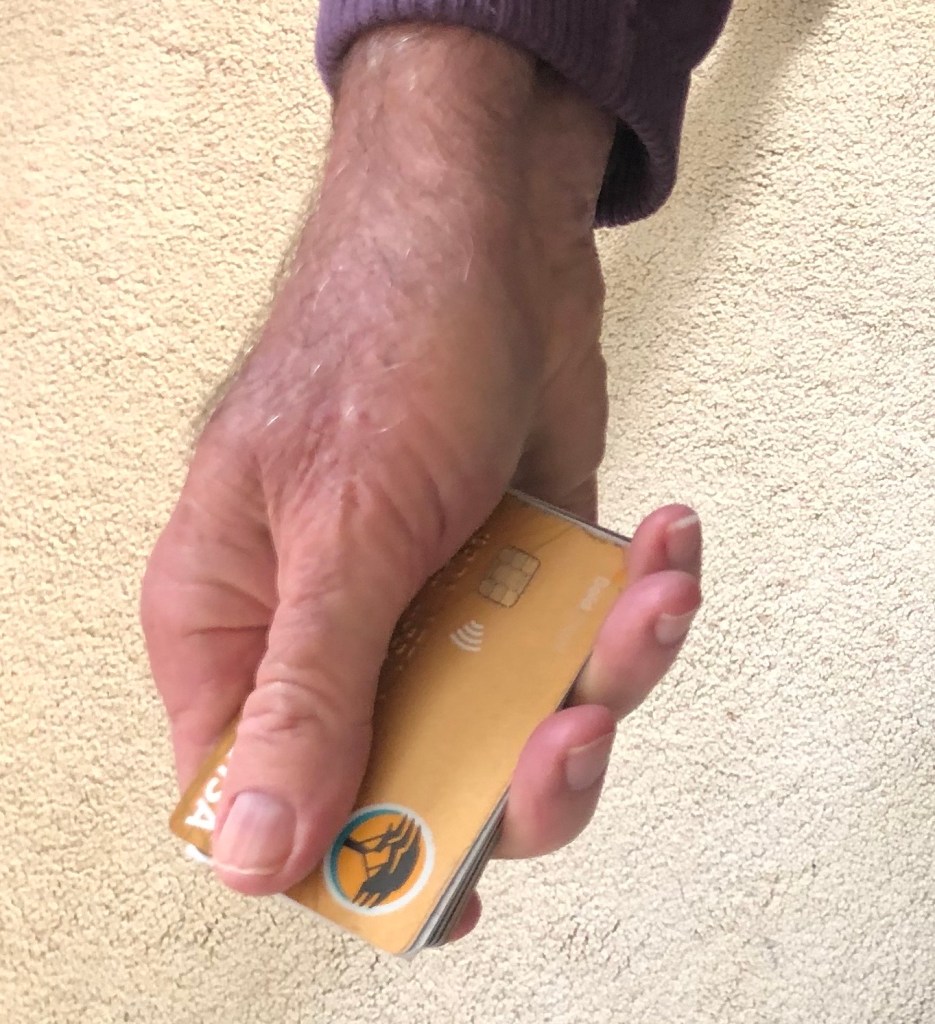
I told her that I would hold some of my cards in my hand on a chance that the combined energy of the cards in my hand would somehow sync with the energy of the missing card and lead me to it.

What a crazy idea! But please read on.

So I did just that. With the clump of cards in my hand I felt inclined to search again on the dining room floor using a torch. No card.

I then felt inclined to go onto the front porch and look under our dog’s blanket. No card.

Then, still holding my clump of cards I felt drawn to look at the gate area. I looked all around. I even looked in a pile of pine needles near the gate. No card.

I was about to go back inside when I felt a strong inclination to open the gates and look in the outside driveway.

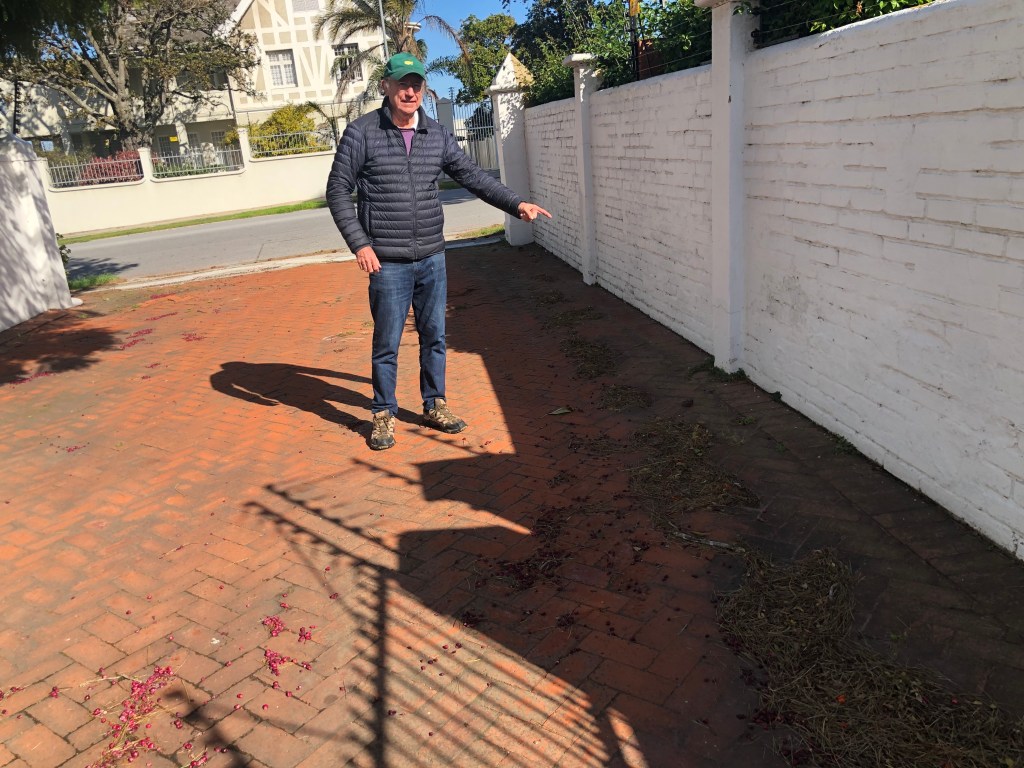
I opened the electronic security gates and walked through, still firmly holding my clump of cards. I walked a few paces and there on my right in the driveway, next to the wall, was the the missing card.

The search was over.

What happened?

You decide.

Socrates the Gadfly

The philosopher Socrates was a great nuisance to the powerful people in Athens long ago. So much so that he called himself the “gadfly”. Why was he a nuisance and why did he call himself a gadfly?

As you may know, a gadfly is flying insect with an extremely painful sting.

Socrates was a nuisance because he kept pestering and stinging the powerful leaders in Athens with difficult questions which showed up their ignorance and their failure to know what they were talking about. He kept stinging them like a gadfly. And Socrates did this in public debate – to the delight of the youth in Athens who no doubt then started questioning the wisdom of their elders.

This was too much for the exposed elite. Like Joseph’s brothers they decided that “the dreamer has to go”. In this case it was Socrates who had to go.

Like a gadfly!

So, the exposed and stung elite trumped up a charge against Socrates: “Corrupting the youth of Athens” (code for: “He persuaded the youth to think for themselves”).

We all know the result. Trial, death sentence and the hemlock.

And another result: Socrates became one of the most respected philosophers and seekers after truth, of all time.

A word of caution: Think twice before you decide to become a gadfly.

Belief System Power: Ask the Fox

(On a mobile please scroll down past the picture. Thank you.)

Things that happen to us make us happy or sad.

What is going on here?

It’s all about our belief system. Each person has their own belief system.

Take fox hunting with hounds.

Photo by Alex Andrews on Pexels.com

Some people think it is cruel because their belief system tells them that it is cruel to tear a live animal to pieces.

On the other hand, some people’s belief system tells them foxes are vermin and it does not matter how they are exterminated.

So, you see it all depends on the belief system.

And we all have one.

I wonder what the fox thinks.

Matrix thinking and a warning during COVID19

Photo by Andrea Piacquadio on Pexels.com

The matrix below is offered to help us think about the relationship between Shut Down Options, the Economy and the Health of the Population. The matrix applies to any country. Even seeing where the matrix is wrong and how it can be improved may help. I hope so.

It goes without saying we need a vaccine desperately and also, if possible, a cure.

Our thoughts are with all those suffering during the pandemic.

In the meantime the question is: What is the best way forward for the economy and the health of the population?

Options Matrix

Conclusion

Photo by Pixabay on Pexels.com

The only option to save the economy and the health of as many people as possible is to have a limited economic shutdown combined with limited social distancing (strictly enforced), supported by a general population committed to self-enforcement.

Warning: Committed self-enforcement by the general population is vital.

Keep safe.

A huge thank you to all Health and Essential Workers world wide.

Thank you.

Questioning “probably”

Digging for more information

When a person says that something will probably happen or probably not happen, the statement does not mean much unless the person speaking answers three important questions.

Take for example.

A person says: “Those plants will not grow”.

Photo by Tobias Bjørkli on Pexels.com

First Question: What is the probability of the plants not growing? Is it”low probability”, “medium probability” or “high probability”?

This first question seeks a rough indication of the degree of probability.

The answer might be:'”Low”.

Second Question: Why do you say “low”?

The second question looks for the evidence that led to the degree of probability.

The answer might be: “Low, because you have planted them in a bed that gets sun all day and those plants like the shade.”

Third Question: What evidence would change your mind?

This third question wants useful information on the way forward.

The answer might be: If you replant the plants in a shady part of the garden, they will have a better chance of success.

Comment

These three questions can be used any where. It would be useful for a reporter to use them at a news briefing by a politician.